
How clinics lose patients to missed calls, and how to fix it
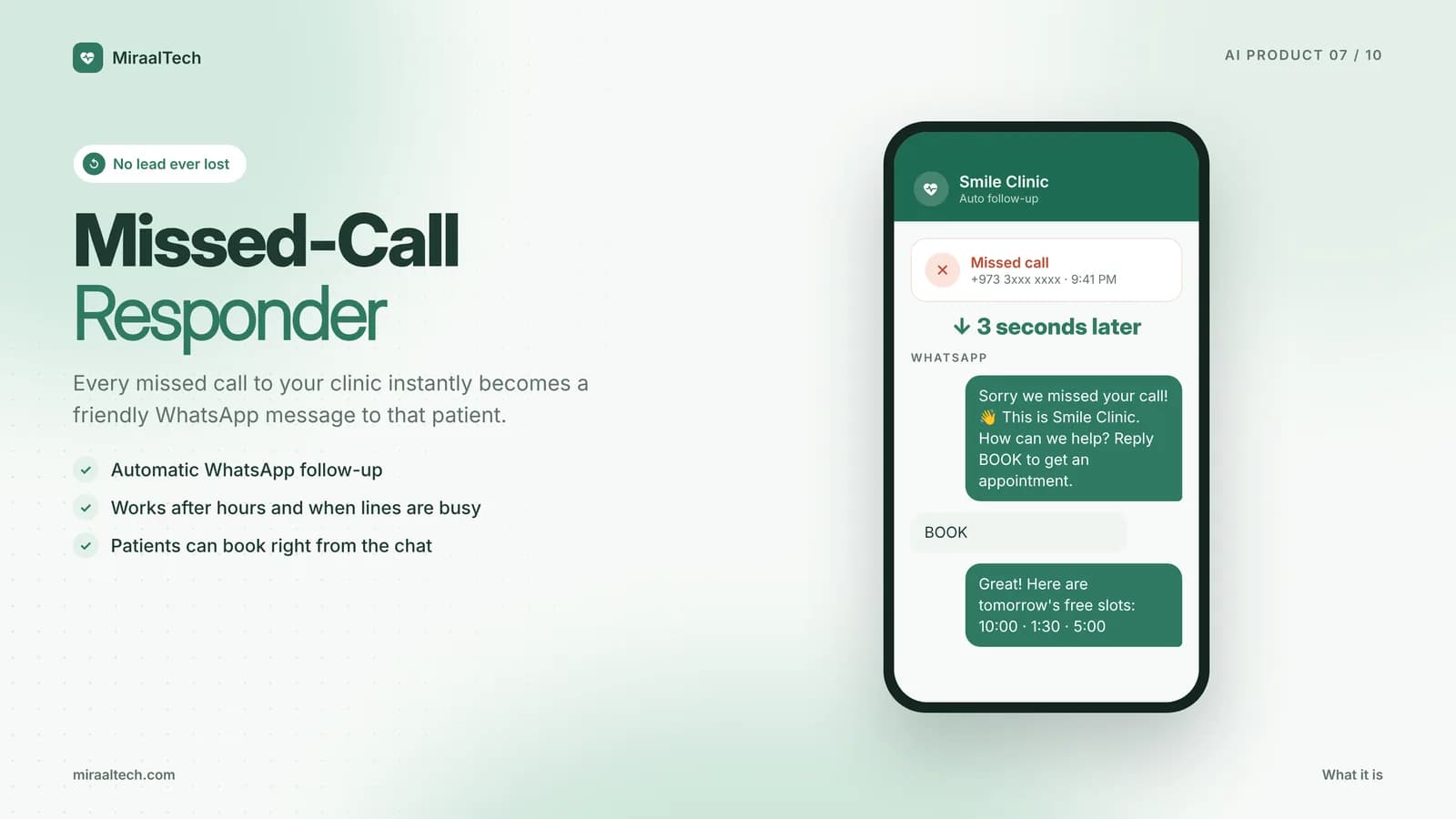
The patient who cannot get through does not wait. They book the next clinic that answers. Here is why missed calls are a growth leak - and how voice AI and WhatsApp close it.

Insights
Patient Communication
Automated reminders are the single most effective tool for reducing no-shows, but the channel you send them on decides how well they work. For most clinics the choice comes down to SMS versus WhatsApp, and the two are not equal.
SMS reaches any phone without an app and is familiar to everyone. Its weakness is that it is one-way and plain: a patient reads it but cannot easily reply, confirm, or reschedule within the message, and rich content is limited.
WhatsApp messages tend to be opened quickly and support two-way conversation. A patient can confirm, reschedule, or ask a question right in the chat, and the message can carry richer content. That interactivity is what turns a reminder into an action.
Book a free consultation with our healthcare software team in Manama.
For a basic nudge, SMS is fine. For reminders that let patients respond and reschedule, cutting no-shows further, WhatsApp usually wins, especially where patients already use it daily. Many clinics use WhatsApp as the primary channel with SMS as a fallback.
Is WhatsApp better than SMS for reminders? For interactive reminders that let patients confirm or reschedule, WhatsApp usually performs better. SMS is simpler but one-way.
Can I use both? Yes. Many clinics lead with WhatsApp and fall back to SMS for patients who prefer it.
MiraalTech sets up automated reminders on the channels your patients actually use. If you want fewer no-shows, get in touch.
Noman Shahid
Product Manager

The patient who cannot get through does not wait. They book the next clinic that answers. Here is why missed calls are a growth leak - and how voice AI and WhatsApp close it.
Translating an English chatbot is not an Arabic product. GCC patients notice tone, RTL, and whether the clinic sounds like it was built for them.

Patients are already asking AI about their health before they call you. Here is how to use it safely.
We use cookies to improve your experience on our site. By continuing, you agree to our Cookies Policy and Privacy Policy.